How Step Challenges Trick Your Brain Into Exercising
Why Step Challenges Are So Addictive (And Why They Actually Work)
Let’s be honest.
Most people know they should exercise more.
That’s not the problem.
The problem is convincing yourself to go for a walk after work when your couch looks comfortable, your phone is entertaining, and your motivation disappeared sometime around 2:15 PM.
That’s where step challenges become weirdly powerful.
Because somehow, the moment walking becomes a competition, people start doing things they would never normally do.
Suddenly your coworker is pacing their kitchen at 10:30 PM trying to protect their leaderboard position like it’s the Olympics.
Someone else is parking six miles away from the grocery store for “extra steps.”
And yes, many people absolutely walk laps around their house while brushing their teeth.
Fitness apps did not invent this behavior.
Psychology did.
Step Challenges Turn Exercise Into a Game
This is the real secret behind why step challenges work.
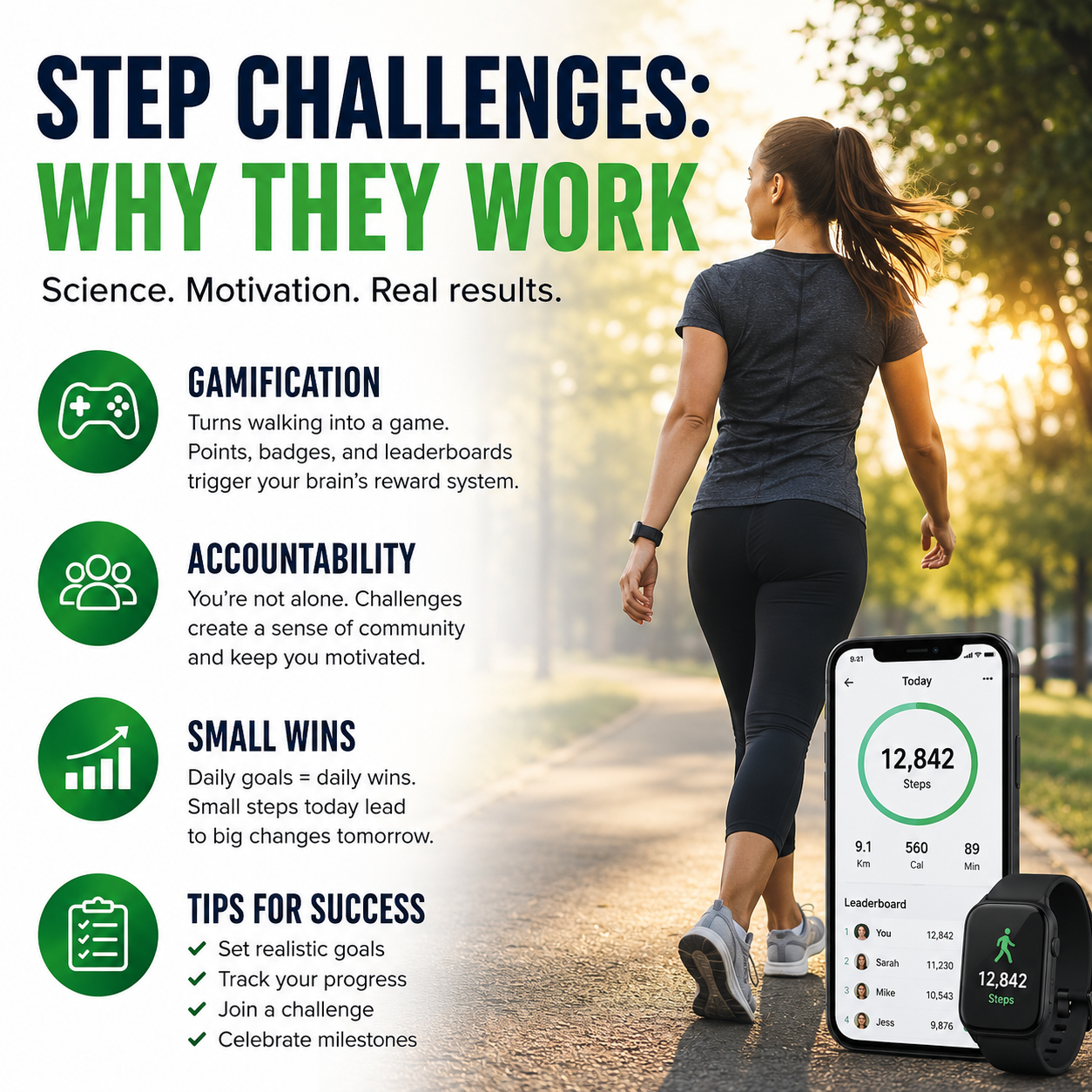
They transform movement from a task into a game.
And humans love games.
The moment you add:
- points
- streaks
- leaderboards
- badges
- milestones
- friendly competition
your brain starts viewing walking differently.
Instead of:
“I have to exercise.”
It becomes:
“I can probably pass Dave if I do one more lap around the block.”
That tiny mental shift matters a lot.
Because games create reward loops.
Every time you hit your step goal, close a streak, or move up the leaderboard, your brain releases dopamine. That’s the same reward chemical tied to motivation and habit formation.
Your brain basically says:
“Hey… that felt good. Let’s do it again.”
And just like that, walking becomes something you want to do instead of something you force yourself to do.
Competition Motivates People More Than They Admit
People love to say:
“I’m not competitive.”
Then they lose first place by 400 steps and suddenly take a “quick evening walk” at 9:47 PM.
Step challenges work because competition adds urgency and excitement to something that would otherwise feel repetitive.
You are no longer walking in isolation.
You are participating.
That social element changes everything.
Research consistently shows people are more likely to stick with healthy habits when they feel connected to a group. Accountability matters. Shared goals matter. Even light social pressure matters.
Nobody wants to be the only person in the group sitting at 1,200 steps by dinner.
Small Wins Build Momentum Fast
One reason step challenges work so well is because success feels achievable.
Running a marathon sounds intimidating.
Walking a little more today than yesterday?
That feels manageable.
And those small wins matter psychologically.
Every completed goal tells your brain:
“I’m capable of this.”
That creates momentum.
One good day turns into three.
Three turns into a streak.
The streak becomes part of your routine.
Over time, people stop identifying as “someone trying to get healthier” and start becoming “someone who walks every day.”
That identity shift is huge.
Tracking Progress Changes Behavior
This part is underrated.
The simple act of tracking your steps changes your awareness dramatically.
A lot of people think they’re active until they actually look at the numbers.
You spend all day busy, answer emails, clean the house, survive work stress, and somehow your watch calmly informs you that you’ve taken 2,143 steps.
Rude.
But useful.
Because once you can see your habits clearly, you can improve them.
Tracking turns vague intentions into measurable behavior.
And measurable behavior is easier to improve.
Why Step Challenges Feel More Fun Than Traditional Fitness
Traditional fitness often feels intimidating.
Gyms can feel uncomfortable for beginners.
Workout plans can feel overwhelming.
Social media fitness culture can make people feel like they need perfect routines, expensive gear, and abs carved from marble.
Walking is different.
It feels accessible.
Almost anyone can start.
You do not need elite athletic ability.
You do not need to “be a fitness person.”
You just need shoes and a little consistency.
Step challenges take that simplicity and add motivation, accountability, and fun.
That combination is incredibly effective.
The Real Goal Isn’t Winning
Ironically, the people who benefit most from step challenges are not usually the people winning them.
The real win is:
- moving more consistently
- building healthier habits
- improving energy
- creating momentum
- becoming more active without hating the process
That’s what makes step challenges powerful long term.
They help people associate movement with progress instead of punishment.
And honestly, that mindset shift can change everything.
Final Thoughts
The psychology behind step challenges is actually pretty simple:
Humans enjoy progress.
Humans enjoy competition.
Humans enjoy rewards.
Humans enjoy belonging to something.
Step challenges combine all four.
That’s why they work so well.
Not because walking suddenly becomes magical, but because the experience becomes engaging enough that people finally stay consistent long enough to see real results.
And in fitness, consistency almost always beats intensity.
Comments
Join the conversation on this article.
Log in to comment.
LoginNo comments yet.