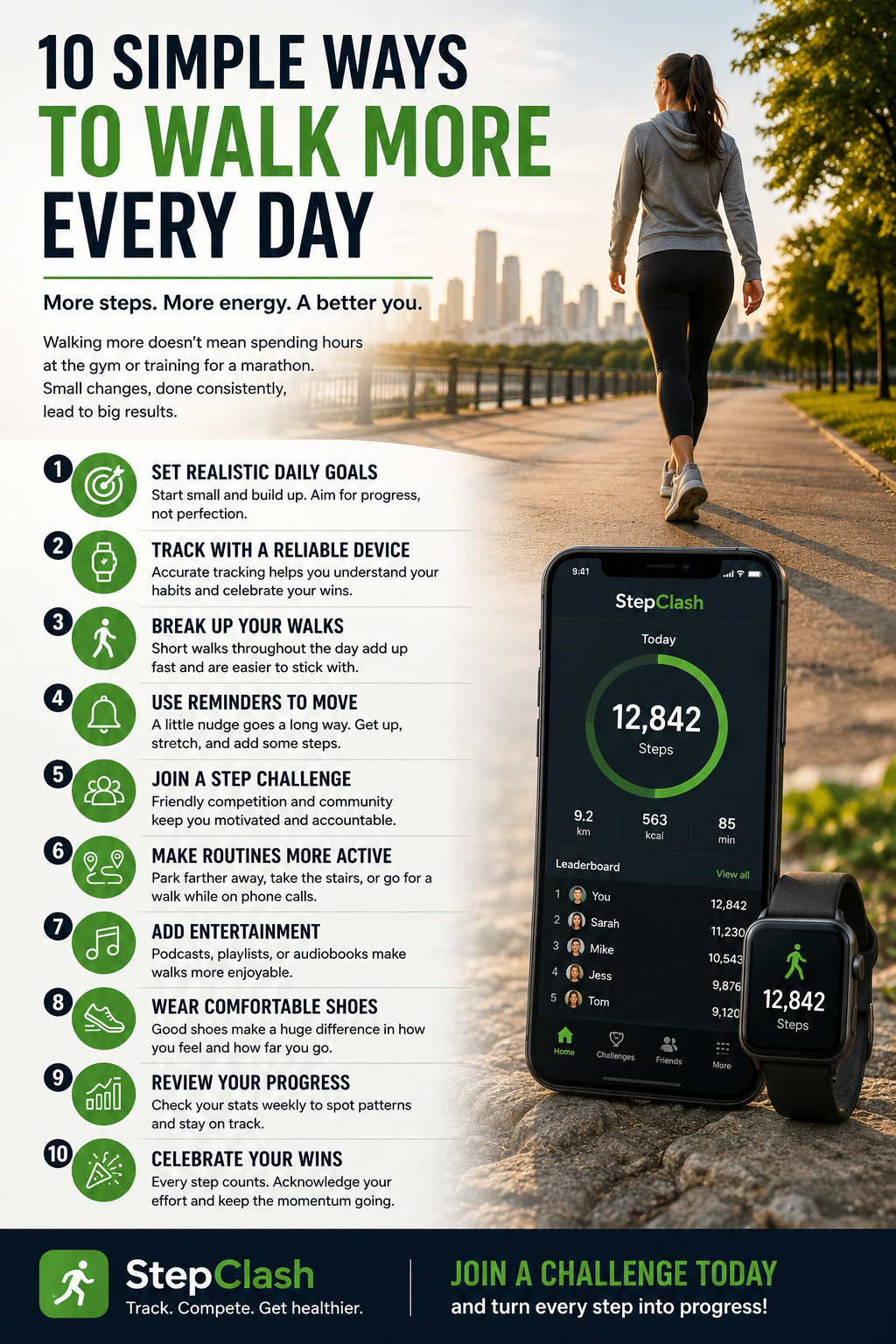
10 Simple Ways to Walk More Every Day Without Overcomplicating It
10 Simple Ways to Walk More Every Day (Without Completely Changing Your Life)
Let’s be honest.
Most people do not wake up one day magically excited to hit 10,000 steps.
Usually it starts with:
“I should probably move more.”
Then you buy a smartwatch, check your step count at 8 PM, and realize your body has basically been operating in power-saving mode all day.
Modern life makes sitting incredibly easy.
We sit at work.
We sit while driving.
We sit while watching Netflix while “resting from sitting.”
The good news is walking more does not require a complete lifestyle overhaul or training like you’re preparing for Everest.
Small changes add up fast.
And over time, those extra daily steps can improve:
- energy levels
- sleep quality
- mood
- cardiovascular health
- consistency
- overall fitness
Most importantly, walking is sustainable. You do not need elite athletic ability or expensive equipment to make progress.
Here are 10 realistic ways to walk more every day without making your life miserable.
1. Stop Obsessing Over 10,000 Steps Immediately
This is where a lot of people accidentally sabotage themselves.
They go from averaging 2,700 daily steps straight to aiming for 10K because social media convinced them that anything less basically “doesn’t count.”
Relax.
A better strategy is building gradually:
- 5,000 steps
- then 6,000
- then 7,500
- then higher over time
The best step goal is the one you can consistently hit.
Because consistency changes your life.
Random motivation bursts do not.
2. Track Your Steps Without Becoming Emotionally Controlled by Your Watch
Step tracking is incredibly useful.
It builds awareness fast.
But some people start checking their watch every 14 seconds like they’re day trading stocks.
Do not overcomplicate it.
Use:
- a smartwatch
- your phone
- a fitness tracker
- whatever you’ll actually use consistently
Tracking works because it turns vague assumptions into real information.
A lot of people feel active until their tracker politely informs them they’ve walked 1,943 steps by supper.
Painful.
But helpful.
3. Break Walks Into Smaller Pieces
You do not need one giant walk every day.
In fact, smaller walks are often easier to maintain long term.
Try:
- a 10-minute morning walk
- walking after meals
- pacing during phone calls
- quick breaks during work
- a short evening walk
Those little chunks stack up surprisingly fast.
And mentally, “walk for 10 minutes” feels much easier than “go exercise.”
That matters more than people think.
4. Make Your Walks Less Boring
Walking gets easier when it stops feeling like punishment.
Because nobody wants to stare at the same sidewalk in silence for 45 minutes while questioning every life decision.
Add entertainment:
- podcasts
- audiobooks
- playlists
- phone calls
- scenic routes
Some people even save their favorite podcast specifically for walks so their brain starts associating movement with enjoyment.
That’s smart psychology.
5. Use Your Environment to Your Advantage
This sounds simple because it is simple.
Tiny environmental changes create more movement automatically:
- park farther away
- take the stairs
- walk to nearby errands
- use the bathroom on another floor
- stand while working occasionally
None of these feel important individually.
But repeated daily?
Huge difference.
Your habits are often shaped more by convenience than motivation.
6. Use Step Challenges to Stay Motivated
This is where walking suddenly becomes weirdly addictive.
The moment you join a challenge, everything changes.
Now your evening walk is no longer “exercise.”
It’s strategy.
Suddenly people are:
- checking leaderboards constantly
- pacing while brushing their teeth
- taking “victory laps” through the kitchen at 11 PM
- protecting first place like it’s a professional sport
And honestly?
It works.
Friendly competition creates accountability, momentum, and consistency in a way solo fitness often does not.
Platforms like StepClash make daily movement feel social, interactive, and rewarding instead of repetitive.
That small mental shift matters a lot.
7. Wear Comfortable Shoes
This one sounds obvious until you realize how many people try to become “more active” while wearing shoes designed by medieval torture engineers.
Good walking shoes matter.
You do not necessarily need expensive shoes, but comfort changes everything:
- less soreness
- less fatigue
- better consistency
- longer walks
- fewer excuses
Your feet are doing the work.
Treat them decently.
8. Review Your Progress Weekly
One of the coolest things about tracking steps is seeing patterns emerge.
You start noticing:
- weekends are lower
- workdays are more active
- stress affects movement
- mornings work better than evenings
That information helps you improve realistically instead of relying on guesswork.
Data is useful because it removes the:
“I think I’m doing okay”
feeling.
Now you actually know.
9. Celebrate Small Wins
Most people only celebrate giant milestones.
That’s a mistake.
Celebrate:
- your first consistent week
- a personal best
- hitting a streak
- choosing movement when you did not feel like it
Those moments matter because they build identity.
You stop feeling like someone trying to get healthier and start becoming someone who simply moves consistently.
That mindset shift is huge.
10. Remember That Every Step Counts
This is probably the most important point in the entire article.
Walking more is not about perfection.
You do not need flawless routines.
You do not need marathon-level discipline.
And you definitely do not need to panic-walk circles around your house before midnight every night.
You just need to move a little more than before.
That’s it.
Small improvements repeated consistently are what create long-term change.
Final Thoughts
Walking more every day is one of the simplest ways to improve your health, energy, and consistency without overwhelming yourself.
The trick is making it realistic.
Not extreme.
Not perfect.
Not all-or-nothing.
Just sustainable.
Because the people who succeed long term are usually not the people who go hardest for one week.
They are the people who keep showing up long enough for healthy habits to become normal life.
Comments
Join the conversation on this article.
Log in to comment.
LoginNo comments yet.